
Effective cleanroom contamination control is about much more than managing airborne particles. While particulate control is essential for pharmaceuticals, biotechnology, electronics, and nutraceutical manufacturing, several other environmental factors play an equally important role in maintaining cleanroom integrity. Humidity, gas-phase contaminants, and microbial risks can all impact product quality, research accuracy, and regulatory compliance. Modular Cleanrooms incorporates these considerations into every cleanroom design, ensuring reliable performance that aligns with ISO 14644 standards and industry expectations.
A cleanroom must operate as a carefully balanced ecosystem. Every component—from airflow systems to surface materials—works together to protect processes and prevent contamination. Understanding these risks helps organizations make informed decisions during cleanroom planning and operation.
The Role of Humidity in Cleanroom Contamination Control
Humidity has a direct effect on cleanroom contamination control, especially in processes involving powders, hygroscopic materials, or delicate components. When humidity drifts outside the acceptable range, it can cause powders to clump, ingredients to degrade, and sensitive electronics to attract particles through static discharge. Even slight moisture increases can enable microbial growth on surfaces, equipment, or packaging materials.
Because these issues can compromise entire batches, Modular Cleanrooms integrates HVAC systems capable of maintaining precise humidity levels. The goal is not only to meet ISO and GMP guidelines but also to support consistent manufacturing conditions day after day. By stabilizing humidity, cleanrooms become safer, more predictable environments for mixing, coating, encapsulation, and assembly.
Gas & Chemical Contamination: An Overlooked Risk
Cleanrooms are often judged by their particle counts, yet gas and vapor contamination can be just as damaging—and play a major role in effective cleanroom contamination control. Volatile organic compounds (VOCs), solvent vapors, and off-gassing chemicals can enter through construction materials, cleaning agents, adhesives, or process-related chemicals.
Gas-phase contaminants can:
- alter chemical formulations,
- interfere with analytical testing,
- damage sensitive electronics, and
- trigger false readings in research and diagnostics.
To reduce these risks, Modular Cleanrooms uses low-VOC materials, sealed surfaces, and ventilation strategies that dilute or exhaust harmful vapors. When necessary, carbon filtration or specialized absorbent technologies can be incorporated to control VOCs. This ensures that cleanroom air is not only particle-free but chemically stable enough to protect sensitive operations.
Understanding Microbial Risks in Controlled Environments
Microbial contamination remains a concern in industries where sterility, purity, or product longevity is essential. People are often the primary source of microbes through skin cells, clothing fibers, and respiratory droplets. Surfaces can also harbor microbial growth if not designed for easy cleaning or if moisture accumulates in corners, seams, or equipment gaps.
Modular Cleanrooms addresses microbial risks through smart design features such as:
- smooth, non-porous wall and ceiling panels,
- properly designed airflow patterns,
- clearly defined gowning and transition areas, and
- pressure cascades that minimize contamination migration.
Combined with appropriate cleaning schedules and operator training, these design elements help maintain microbial control even in tightly regulated environments like pharmaceutical manufacturing or sterile packaging.
How Modular Cleanrooms Approaches Total Cleanroom Contamination Control
What sets us apart is our commitment to cleanroom contamination control, not just particle filtration. Every system—in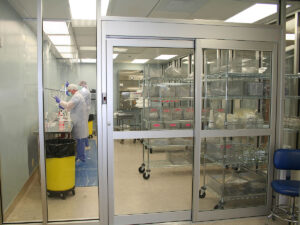 cluding specialized options like our Aluminum BioClean Cleanroom, designed for high-performance biological and pharmaceutical applications—is engineered with careful attention to humidity, temperature stability, vapor management, microbial risks, and overall workflow. Our team develops airflow systems with precise air change rates and pressure control, selects materials that minimize off-gassing and withstand rigorous sanitization, and designs layouts that support efficient movement through airlocks, gowning rooms, and controlled zones. All cleanrooms align with ISO and cGMP expectations, ensuring your facility meets regulatory requirements from the start. This integrated approach ensures your cleanroom protects your products, your equipment, and the teams who depend on it.
Creating a Cleanroom That Protects Your Process
True cleanroom contamination control requires careful planning, proper materials, and environmental systems designed to anticipate every potential risk—not just airborne particles. By addressing humidity, gases, microbial threats, and workflow efficiency, Modular Cleanrooms creates controlled environments that support product quality, research accuracy, and regulatory confidence.
When you partner with us, you’re investing in a cleanroom designed to protect your process and perform with consistency—today and for years to come.