
An effective cleanroom layout is about far more than enclosing a space and installing filtration. The most successful cleanrooms are intentionally planned to support how people work while maintaining stable environmental conditions like temperature, humidity, and pressure. When cleanroom layout and environmental control are designed together, facilities operate more efficiently, reduce contamination risks, and support consistent outcomes across industries such as pharmaceuticals, biotechnology, electronics, and nutraceutical manufacturing.
Here at Modular Cleanrooms, it is approached as part of a complete system—one that aligns airflow, environmental stability, and physical organization with the real-world demands of daily operations.
Why Workflow Matters
Workflow is one of the most overlooked aspects of cleanroom layout, yet it has a direct impact on contamination prevention and productivity. How personnel, materials, and waste move through a cleanroom can either reinforce cleanliness or introduce unnecessary risk.
A poorly planned layout can create cross-contamination pathways, bottlenecks, and inefficiencies. When clean and dirty pathways overlap or gowning areas are poorly positioned, contaminants are more likely to migrate into controlled zones. Thoughtful design ensures that personnel move logically from lower- to higher-cleanliness areas, materials enter through controlled transfer points, and waste exits without crossing critical workflows.
Our layouts are engineered to clearly separate these flows. Gowning rooms, airlocks, and pass-through chambers are positioned to support proper sequencing, helping teams maintain cleanroom discipline without slowing down operations.
Minimizing Cross-Contamination Through Layout Planning
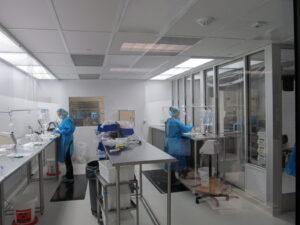
Physical organization is an effective contamination control tool. Zoning is a key strategy, with defined areas for preparation, production, packaging, and exit. Each zone is designed with appropriate airflow patterns and pressure relationships to prevent contaminants from moving upstream.
For example, positive pressure zones help protect critical production areas, while lower-pressure spaces contain contaminants in less sensitive zones. When cleanroom layout and airflow work together, the environment becomes more forgiving of normal human movement and operational demands.
This layout-driven approach reduces reliance on procedural controls alone and builds contamination prevention directly into the physical environment.
Environmental Stability Begins with Layout
Environmental stability is a core pillar. Temperature, humidity, and pressure must remain consistent to protect sensitive products and processes. Fluctuations can disrupt powder flow, affect ingredient stability, increase static discharge, and contribute to microbial growth.
Cleanroom layout directly influences environmental stability through:
- HVAC system sizing and placement, ensuring even distribution of conditioned air
- Air change rates and airflow patterns that support contamination control
- Pressure relationships between rooms to prevent unwanted particle migration
- Material selection that resists moisture absorption and off-gassing
By engineering these elements together, we create cleanroom layouts that maintain stable conditions without overworking mechanical systems—supporting both energy efficiency and long-term performance.
How HVAC and Airflow Support Cleanroom Layout Goals
HVAC systems are the backbone of environmental control, but their effectiveness depends heavily on cleanroom layout. Air supply and return locations, ceiling configurations, and room geometry all influence how air moves through the space.
In a well-executed cleanroom layout, airflow supports both cleanliness and workflow. Air is delivered evenly, contaminants are swept away from critical processes, and pressure differentials are maintained between adjacent spaces. This coordination helps ensure temperature and humidity remain stable even as personnel and materials move throughout the cleanroom.
At Modular Cleanrooms, HVAC planning is integrated early in the cleanroom layout process so airflow strategies align naturally with layout decisions rather than being added as an afterthought.
Modular Layouts for Flexible, Efficient Operations
One of the advantages of modular systems is their ability to support evolving cleanroom layouts. Modular Cleanrooms designs layouts that can be reconfigured, expanded, or upgraded as workflows change—without compromising environmental control.
This flexibility allows facilities to adapt to new product lines, increased production volumes, or changing regulatory requirements while maintaining consistent cleanroom layout principles over time.
Where Efficiency and Control Come Together
A successful design aligns workflow efficiency with environmental stability. When layout, airflow, and environmental controls are planned together, cleanrooms become easier to operate, easier to maintain, and more reliable long term.
Our cleanroom layout is driven by how facilities actually function—creating controlled environments that support productivity, protect processes, and perform consistently well into the future.