
Cleanroom Filtration: HEPA vs ULPA Filters Explained
The right cleanroom filtration system helps protect sensitive products and processes from airborne contamination. Two common options are HEPA and ULPA filters, both designed to capture extremely small particles and maintain controlled environments. But when comparing HEPA vs ULPA, does higher filtration efficiency always mean better performance? Understanding their differences can help facility managers choose a system that meets their cleanliness requirements without adding unnecessary complexity or expense.
What’s the Difference Between HEPA and ULPA?
HEPA stands for high-efficiency particulate air, while ULPA stands for ultra-low penetration air. Both use filter media to capture particles as air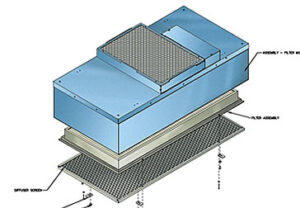 passes through, but their specified performance levels differ.
For a comparison, consider the MAC 10 IQ fan filter unit offered by Modular Cleanrooms:
- HEPA option: Rated 99.99% efficient at 0.3 microns.
- ULPA option: Rated 99.9995% efficient at 0.12 microns.
A micron is one-millionth of a meter, and these particles are invisible. These figures are measured at different particle sizes, however, and should not be read as a direct, like-for-like efficiency test.
When Is HEPA Filtration a Good Fit?
HEPA filtration is used across many controlled manufacturing and research environments, including electronics, medical device production, and biotechnology. It can support demanding airborne particle limits when paired with appropriate airflow, room design, and operating procedures.
The important question is not whether a filter has the highest available efficiency. It is whether the complete cleanroom filtration system can consistently maintain the conditions the process requires. Filter selection should begin with those requirements, rather than an assumption that every application needs ULPA.
When Might ULPA Filtration Make Sense?
ULPA filters offer a higher specified collection efficiency for very small particles. They may be appropriate for especially sensitive processes where additional particulate control is needed and supported by the overall system design.
That added performance comes with design considerations. Depending on the filter and operating conditions, higher resistance to airflow may affect fan selection, energy use, and maintenance planning. A facility should evaluate these factors rather than assuming a filter swap leaves airflow unchanged.
Does Better Filtration Automatically Mean a Cleaner Room?
Not necessarily. Even a highly efficient filter cannot make up for poorly distributed air, leaking seals, blocked returns, or particle-generating activities inside the space. Successful cleanroom filtration depends on how the components work together.
ISO 14644-1 classifies air cleanliness by airborne particle concentration. It does not assign one universal filter type to every ISO class. Meeting a target classification requires the room to perform as designed, not simply installing the filter with the highest percentage on its specification sheet.
Four Questions to Ask Before Choosing a Filter
A useful HEPA vs ULPA comparison should consider more than the numbers. Before selecting equipment, ask:
- What cleanliness level is required? Start with the applicable ISO classification and any customer or industry requirements.
- How sensitive is the process? Consider the particle sizes and contamination risks that matter to the work being performed.
- Can the system deliver the needed airflow? Review fan capacity, filter resistance, layout, and pressure relationships.
- What will maintenance involve? Think about filter access, replacement schedules, monitoring, and operating costs.
These questions help align cleanroom filtration with the facility’s actual needs rather than treating one filter category as the default answer.
Build Filtration Around Your Application
Modular Cleanrooms offers MAC 10 fan filter units with HEPA filtration and optional ULPA configurations, including choices for airflow control and room-side filter replacement on select models. These options allow the filtration approach to be considered alongside the layout and performance goals of the space.
Whether a facility uses HEPA or ULPA, the aim is the same: reliable particle control supported by a properly designed, maintained, and tested system. Explore Modular Cleanrooms’ filtration options to find a configuration suited to your application.