
Designing cleanroom air is a balancing act: you need the cleanliness level your process requires, plus stable temperature, humidity, and pressure, all without turning your HVAC into the most expensive “machine” in the facility. In modular builds and retrofits, the smartest approach is usually a deliberate blend of cleanroom air recirculation (for particle control and stability) and makeup air (to replace exhaust and manage certain process risks).
What “Makeup Air” Really Does in a Cleanroom
It is outside air brought in to replace the cleanroom air you exhaust. If you have fume hoods, solvent exhaust, powder capture, or any process that pushes it out of the space, you need enough makeup air to keep rooms from going negative unintentionally. That matters because pressure relationships help determine where it moves, and movement determines where contaminants can travel.
The catch is conditioning. Outdoor air typically requires heating or cooling and often dehumidification or humidification to meet your setpoints. That load can be the biggest reason a project feels like it “breaks” HVAC budgets, even when the room itself is not huge.
Why Recirculation Carries Most of the Particle-Control Load
For many particle-driven applications, recirculation is the workhorse. Instead of constantly conditioning new outdoor air, you continuously pull room air back through HEPA filtration and send it back as high-quality supply. Modular Cleanrooms specifically calls out designing exhaust/recirculation systems that remove contaminants while recirculating clean cleanroom air, with an eye toward both performance and energy efficiency.
This is also where ceiling fan filter units (FFUs) are common. FFUs provide localized filtration and airflow where you need it, and outside sources describe them as compact purification units equipped with HEPA (or ULPA) filters for controlled environments.
The Three Drivers That Decide Your Mix: Exhaust, Heat, and Pressure
A practical way to choose between makeup air and recirculation is to start with three realities that directly affect cleanroom air performance:
1) Exhaust requirements (process first).
If you must exhaust air for safety or compliance, makeup air is non-negotiable. The design challenge becomes “how little outside air can we use while still meeting the need,” while letting recirculation do the heavy lifting for particles.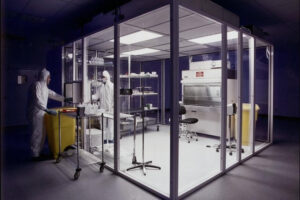
2) Heat loads (comfort and stability).
People, lighting, and equipment dump heat into the room. Even with excellent filtration, poor heat removal makes the environment uncomfortable and can destabilize your process. A recirculating approach often helps maintain tighter temperature and humidity control because you are not constantly battling outdoor swings.
3) Pressure intent (keep contaminants out or keep hazards in).
Positive pressure is used to protect product from adjacent spaces, while negative pressure is used to contain hazards. Either way, pressure only stays stable when supply, return, exhaust, and makeup are engineered as a system.
“More Outside Air” Is Not the Same As “Cleaner”
A common misconception is that more makeup air equals better cleanliness. For particles, cleanliness is primarily driven by filtration efficiency and airflow patterns, not unlimited outdoor air. Recirculating designs are often used specifically because they cycle pre-cleaned air through HEPA filters for efficiency and consistent environmental control, helping maintain stable cleanroom air without constantly reconditioning new outdoor air.
So if your core problem is particles, it is often smarter to improve airflow distribution, returns, and filter coverage than to pay to condition excessive outside air.
Retrofit-Friendly Upgrades That Protect Your HVAC Budget
If you are adapting an existing building, you can often improve performance without a full mechanical overhaul:
- Right-size exhaust and replace it with controlled makeup. Start with what the process truly needs, then match makeup to maintain stable pressure.
- Use fan controls and setbacks. Modular Cleanrooms offers a digital control system designed to monitor and adjust FFU airflow remotely and supports scheduling and control approaches that reduce airflow during off-hours while maintaining room intent.
- Fix airflow pathways. Many real-world failures come from dead zones, blocked returns, or supply patterns that stir up contaminants instead of sweeping them away.
A Simple Way to Think About Your Cleanroom Air Plan
If your primary risk is particles, build the strategy around recirculation and HEPA filtration coverage, and use makeup air mainly to replace required exhaust. If your process involves fumes, vapors, or hazardous powders, design exhaust and safety first, then engineer makeup and recirculation so your cleanroom air stays stable, efficient, and compliant. Our design approach at Modular Cleanrooms is centered on tailoring exhaust/recirculation to the application while balancing performance with energy efficiency, which is exactly the decision framework you want before you spend money on bigger HVAC equipment.