
A cleanroom pass through window gives facilities a controlled way to move materials, tools, and supplies between spaces without requiring personnel to enter and exit as often. In environments where particle control matters, every door opening and unnecessary movement can create another opportunity for contamination. A properly placed pass-through can support cleaner workflows while making material transfer more efficient.
What Is a Cleanroom Pass Through Window?
A cleanroom pass through window is a built-in transfer point installed in a wall between adjacent areas. Instead of carrying items through a personnel door, workers can place materials inside the pass-through from one side and retrieve them from the other.
This approach can reduce unnecessary traffic between controlled and less-controlled areas. It can also help facilities separate material movement from personnel movement, which is useful when maintaining organized workflows and limiting disruption inside the room.
At Modular Cleanrooms, we offer customizable wall pass-throughs and cart pass-throughs as options for our hardwall systems. Because our hardwall designs use prefabricated, non-progressive wall panels, individual wall sections can be removed or replaced without disturbing adjacent sections, giving facilities flexibility when planning or modifying transfer points.
How Pass-Throughs Help Reduce Contamination Risk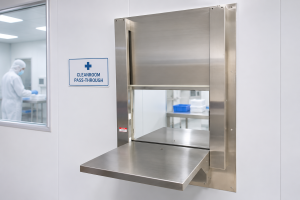
Material transfer may seem simple, but every movement into a controlled environment can introduce particles from packaging, carts, tools, or surrounding spaces. Cleanroom Technology notes that pass-through boxes help create a barrier between adjacent spaces while allowing materials to move between them. A cleanroom pass through window creates a designated path for these materials instead of relying on the same doors used by personnel.
This can reduce door openings and unnecessary foot traffic while giving employees a consistent transfer point for staging, cleaning, receiving, or removing materials. A pass-through also helps standardize workflows, but it should be used alongside proper cleaning, gowning, filtration, and material-handling procedures as part of a broader contamination-control plan.
Wall Pass-Throughs vs. Cart Pass-Throughs
The right transfer method depends on what needs to move through the space. A standard cleanroom pass through window can be a practical choice for smaller tools, parts, samples, containers, or packaged supplies.
For larger or heavier materials, a cart pass-through may make more sense. We list both customizable wall pass-throughs and cart pass-throughs among the available options for our hardwall cleanrooms. Cart-sized openings can support the movement of wheeled equipment or larger loads without forcing those items through a standard personnel entrance.
Choosing between the two starts with understanding the size, weight, frequency, and direction of material movement.
4 Things to Consider When Planning a Pass-Through
Before adding a cleanroom pass through window, consider how it will fit into the overall room design and daily workflow:
- Location: Place it where materials can move efficiently without crossing unnecessary work areas.
- Size: Make sure the opening can accommodate the items that will regularly pass through it.
- Workflow: Consider which side is used for staging, cleaning, receiving, and removal.
- Room requirements: Evaluate pressure, classification, and operating procedures before deciding on the final configuration.
Planning these details early can make the pass-through easier to use and help avoid workflow problems later.
Build Material Transfer Into the Room Design
A cleanroom pass through window can make material movement more controlled without adding unnecessary complexity to the workspace. When placed correctly, it can help reduce traffic, support organized handling procedures, and limit how often personnel doors need to open.
At Modular Cleanrooms, we design customizable hardwall systems with options including wall pass-throughs, cart pass-throughs, air locks, gowning rooms, removable wall sections, and other components. By considering material transfer during the design stage, facilities can create a layout that supports both cleanliness and everyday efficiency.